Révélations circusnext 2026



4 compagnies Lauréates, sélectionnées parmi 10 Finalistes, présenteront chaque soir un fragment de leur spectacle en cours de création. Avis aux amateur·ices de cirque contemporain et aux curieux·ses, venez découvrir ces figures émergentes du cirque contemporain !
En partenariat avec

Cie Inéluctable’s SEUIL: materialising the connection between the inert and the living
Around About Circus · By Valentina Barone
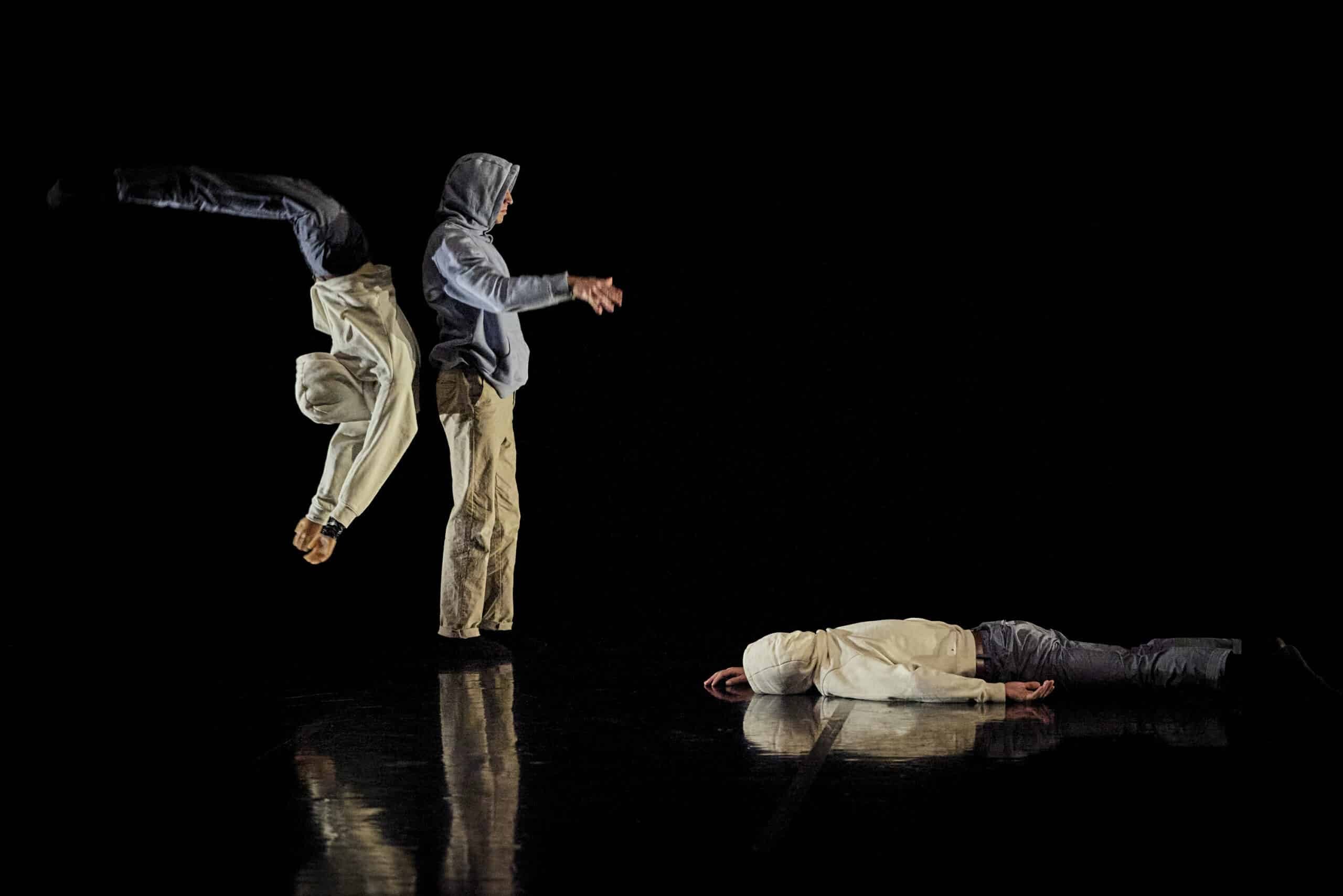
Marius Fouilland and Aimé Rauzier are two acrobats who blend dance, circus, and marionette. In their first co-authorial circus creation, a duo becomes a quartet with two inanimated bodies that seem to double their presence. Trained since childhood in dance (Marius) and circus (Aimé), they met at Académie Fratellini in different promotion years. At school, opportunities to share movement practices increased, until grieving the loss of close circus artist friends touched both and catalysed their attention to it as a shared theme. Marius founded his own company and then invited Aimé to join an acrobatic journey around a puppet with proportions equal to their own, embarking on research into an inert body that plays with their movements in between. With the title Ceux qui restent, the company Inéluctable project became a laureate of circusnext 2025. On stage, the absence of a living body takes the shape of a puppet to be carried, moved, and manipulated. The acrobat’s floor technique is at the service of maintaining an illusion, while the marionette is so similar to a real body that the illusion seems real. The spectator gazes fondly, realising only sporadically who is alive and who is not, feeling the melancholic weight of absent presences that interweave in slow sweetness, or explosive jumps and falls on a reflective surface that amplify the visual game of fiction. For this circusnext interview series, I’ve reached out to the two authors in residency in France to chat about this metaphorical work. Their creation, now entitled SEUIL, will debut in October 2026.
You’ve known each other since your time at the Académie Fratellini, even though you were in different years. How did your collaboration begin?
Marius Fouilland: At school, it happened that we took a few dance classes together. In 2021, my final year, we also presented a carte blanche together – a free-form presentation in which you can create whatever you like. Even back then, I wanted to set up my own company, and the following year, the company Inéluctable was born.
Aimé Rauzier: I’m a year older than Marius, even though he finished school a year before me. I finished school in 2022 and immediately started working as a performer in a variety of very different theatre and circus projects – I would say they are rather hard to pin down into any specific artistic category.
What do circus and dance as disciplines mean to you, and what interests you as creators?
Marius Fouilland: I started training in dance and circus around eight years old, and I have always alternated between the two, often wondering which one I should choose. Now I like to use the term acrodance to describe my practice as a dancer and acrobat. Dance allows me to codify a range of emotions and information that the exceptional nature of acrobatics alone would not be able to express. And yet, if I did not combine dance with acrobatics, I would feel that something was missing. What I love about acrobatics is its explosive energy, combined with the chance to explore gentler movements at a slower tempo. That’s why I’m interested in working on falls and puppet movements. Our project explores a very wide range of movement qualities.
Aimé Rauzier: Before joining the Académie Fratellini, since I was a child, I practised various circus disciplines, so I describe myself as a circus artist. What circus has given me is a physical engagement that I really value, a need for individual expression combined with a spirit of collective adventure. A love of sport, of taking risks, and of expressing emotions through the body. As the sense of discovery, and what my attempt to express myself brings out in another person. All of this is why I got into circus.
Marius Fouillard: I like being responsible for a project, but I also enjoy writing it together with others and discussing different ideas. SEUIL is Inéluctable company’s third artistic creation, the first designed for the theatre, and Aimé and I are its co-authors. As a performer, I am more at the service of others’ ideas; as an author, however, I am interested in talking about something that concerns me, that I have experienced first-hand, and that touches me deeply. In this case, it is about the relationship with death and with those who are no longer with us.

Where did the idea of working with a puppet that looks just like you come from?
Aimé Rauzier: The idea came from Marius and his curiosity about the subject: exploring the loss of a dear friend. The loss of two friends who were circus performers brought us closer together because it was an experience that affected us both. We asked ourselves how we could reflect, both spiritually and practically, on the dimension of the other who no longer exists, on the relationship with those who are no longer alive but are perceived as present. Working on death is unique: it is a dimension that is both distant and close, involving personal, sociological and physical relationships.
In a book that inspired us, Our Grateful Dead: Stories of Those Left Behind, the author Vinciane Despret writes that the dead want to be remembered. The basic idea was there, but one element was still missing: how do we bring to the stage the body of someone perceived as present but no longer alive?
So we started contacting companies that were already working with puppets and, in an initial workshop in March 2024, we tested our research. At that point, we were still uncertain, entering uncharted territory. We showed the material to Aurélien Bory, who pushed us to continue the research, recognising its potential, its symbolic power and the possibility of developing a previously unexplored form of acrodance.
Marius Fouilland: Our first marionette was around twenty kilos. Obviously, the idea is to move it as if it were alive, but because of its weight, every movement felt heavy during our early improvisations. That’s why Aurélien helped us find experts to build the kind of marionette we needed: a circus marionette, capable of performing acrobatics and moving with that kind of fluidity.
We began meeting various companies and puppeteers and got involved in a process that initially seemed risky, expensive and entirely artisanal. Our marionette had to have specific characteristics; it had to be able to be manipulated like a real body and used for falling onto without causing injury. In the end, by bringing together a range of skills, including the expertise of Élise Vigneron from Théâtre de l’Entrouvert and the builder Arnaud Louski-Pane. Thanks to them, we met Alma Roccela and Ninon Larroque, who made the puppets we use in our work.
What are the technical specifications of the puppets you use on stage?
Aimé Rauzier: For the circusnext performance, we used three puppets: two lighter ones made of aluminium, weighing about four kilos, and one heavier one. All have movable joints that allow for articulated movements. The head is made of wood. It fits into the torso and is connected to the neck by two elastic bands, allowing it to bend forwards, backwards and sideways, naturally simulating human movements.
Marius Fouilland: The first scene we presented uses the heavier puppet. The body that falls and is perceived as heavy is subsequently replaced by the lighter puppet, and this creates a sense of disorientation in the audience because they are still expecting a reaction from the previous puppet. Our research into marionettes is still ongoing, and we are experimenting with different weights and movement possibilities. In the future, we do not rule out building other, special marionettes to reproduce specific movements and effects.

How did your participation in circusnext influence the creative process?
Marius Fouilland: Usually, finalists are asked to present an excerpt from existing material, whereas in our case, the process led us to create the 20 minutes we hadn’t yet developed.
Aimé Rauzier: The development of SEUIL is taking two years. In total, we calculated that the show’s development involved 18 residencies. circusnext accelerated the artistic research process, transforming it into a genuine creative journey.
As for the laboratory, we were at the very beginning of the creative process and attended it as individual participants. Working at Dynamo Workspace in Odense, Denmark, with Delphine Lanson was stimulating for me, as was engaging with people from other countries, where the development of circus has a different political significance. It was also useful for raising awareness of the message our show aims to transmit.
Marius Fouilland: My laboratory experience in Serbia, at Cirko Balkana in Zagreb with Zed Zanzu, was also very positive. The puppets did not exist yet, and meeting other authors, creative processes, and realising that everyone has different needs was useful. It enabled us to meet international partners with whom we are set to collaborate, such as those from the Balkans, Italy, Portugal and Lithuania.
Among the artist residencies, Perplx in Belgium represented a very important milestone for us. The team provided us with feedback, invited us to present the project as part of their annual showcase and proposed that we return with the finished piece in 2027.
There are two of you onstage, but who are your collaborators behind the scenes?
Aimé Rauzier: Marius got in touch with Aurélien Bory at the start of the creative process. With his company III, he was looking to work with young circus projects, so it was the perfect opportunity to support us as a young company and with the overall dramaturgy. Aurélien helped us by believing in the project’s development from the beginning, introducing us to the right people, and offering residency support and future booking opportunities at the Garonne theatre in Toulouse, which he directs. He is a key figure in the development of our ideas; meeting with him regularly has allowed us to review the dramaturgy, showcase progress and discuss possibilities.
Marius Fouilland: Behind the scenes, we are supported by a large team. Alma Roccella, Ninon Larroque and Manon Clavreul worked on the creation of the marionettes. Zoé Petrignet collaborated with us on choosing the style of clothing and creating the costumes. We wanted to create new magic effects in a very natural way, using lights and the puppet movements, and for this aspect, we consulted Rachel Cazenave, who did the New Magic training course at CNAC.
The overall external eye is of the actor and puppeteer Matthieu Siefridt, while Sylvère Lamotte helped us with the movement choreography. The sound design is by a young artist, Victor Comby, being his first sound creation for a circus show, while the lighting design is by Greg Desforges.
The two puppets are identical to you in every way. The image suggests the need to engage in a broader sense of otherness. What do these two entities represent to you?
Aimé Rauzier: At first, we were drawn to the confusion created by these two silhouettes. With its masculine features, the puppet is sketched and does not project a clearly defined identity onto the audience. In this way, the confusion between the puppet and the acrobat creates a choreographic interplay that lends itself to open interpretation.
Marius Fouilland: The characters’ development is still in progress. We could say that the fundamental relationship stems from the individual bond between each of us and our own puppet. We bring to the stage two relationships with death that unfold in different ways. At first, the puppet is perceived by the audience as alive because we try to bring it to life. Later on, the way we move with it changes, and it is perceived as a manipulated object.
Aimé Rauzier: The acrobatic dance created with the puppet is explosive and dynamic; its performative dimension expands, and working on the technique is stimulating for this reason, too. We have learnt different ways to carry and move it like a body, especially during falls.
Another interesting aspect is the impact of the choreographic material in relation to what we want to convey, understanding how the puppet manages to manipulate us through the technique of acrodance, and how we can surprise the audience through this shift in register.
Marius Fouilland: We still have many important choices to make regarding this aspect: altering small movements affects the puppet’s behaviour, so it is during this period that we make the most crucial decisions!
When is the project’s premiere scheduled?
Marius Fouilland: SEUIL will debut in October 2026 in France, at Agora, the National Circus Centre in Boulazac.

Marcelo Nunes’ Ghetto: swinging across the chasm of class
Around About Circus · By Valentina Barone
Marcelo Nunes is a Brazilian circus artist who uses clowning, fakirism and trapeze to deliver story-driven performances that explore human nature. He began practising circus arts as a child, attended the Escola Nacional de Circo do Rio de Janeiro, studied trapeze in Argentina and then in Europe at Ésacto’ Lido’ in Toulouse, where he also began practising fakirism. His solo show, GHETTO, stems from a personal artistic need to explore and transform loneliness and social marginalisation into tools for understanding, accepting and liberating one’s own existential condition. The show prompts the audience to question who and what we normally fail to see on the fringes of a society that is unable to empathise with others’ pain or addiction. On stage, the perspective is reversed: it is the marginalised individual and their distress that are the protagonists of a journey that takes us out of our comfort zone. Just as the circus has, over time, reinvented itself and challenged established social codes, Marcelo Nunes’ art speaks out against the homogenising aesthetics of a normative world that prioritises class privilege. Decolonising contemporary circus is possible, and a minority practice such as fakirism becomes an expression of mastery and fulfilment. For the circusnext interview series, I spoke to the artist via video link from Rio de Janeiro.
At what point in your life did you discover circus arts, and how did you become a professional?
Macelo Nunes: From the age of five, through social services supporting vulnerable children in São Paulo, I participated in various cultural activities that I wouldn’t normally have had access to. It was in this context that I discovered circus, around eight years old. I like to think of myself as the second generation of artists in my family, as my first teacher was my great-aunt, my grandfather’s sister. A dancer and model, she was certainly an artist, but found herself in a difficult environment in which to fulfil her potential as such.
I’ve always done juggling and acrobatics too, but clowning was my main discipline until I was eighteen. Then I got a bit fed up with making people laugh and wanted to be seen more, so at the Escola Nacional de Circo in Rio de Janeiro, I specialised in acrobatic base. After finishing my studies in Brazil, I was the coordinator of an organisation that runs activities for vulnerable children. It was a wonderful experience that allowed me to return to my roots in a way that held deep meaning.
And yet, I felt that my desire to be an artist was always there, a voice asking to be heard. Following an injury, I decided to take up the trapeze. I continued my training as a trapeze artist in Argentina and then applied to Ésacto’ Lido’ in Toulouse, where I graduated with my personal project, Pacemaker, from which GHETTO originated.

GHETTO is the artistic expression of your anthropological and social research into the theme of social marginalisation. Where does your focus on the excluded come from?
Macelo Nunes: I come from the ghetto, so this show draws on a social reality I know intimately. This perspective is part of who I am, and when I talk about people living on the margins, I do so from a very personal standpoint because I come from a family with a history of drug abuse and detention.
To society, my mother was of no social significance; her addiction was never seen as a sign of hardship. Yet my mother was unable to receive an education; she had five children and found herself alone, abandoned by a society that failed to help her in a difficult situation.
For me today, speaking four languages is normal, even though I come from a marginalised background. Yet I was only able to talk about my family situation after fifteen years. It was through reflecting on the society in which I lived that I freed myself. To do so, I had to place myself in a position of understanding towards my social condition, integrate myself and learn to talk about it.
Where did the idea for the show come from, and how did GHETTO take shape?
Macelo Nunes: For me, marginality and fragility go hand in hand. It is the sociological aspect of art that interests me: contextualising the individual and exploring why they cannot adapt. It is also for this reason that I eventually began experimenting with the absence of a margin between artist and audience.
In the first year at Ésacto’ Lido, we used to experiment once a month by presenting personal research. At the time, I felt a sense of responsibility for having grown up in a difficult situation. I wanted to stage the experience of being punished by society and its taboos. Fakirism emerged in that context. It arose from the need to explore, as part of a collective process, the theme of exposing shame in front of an audience.
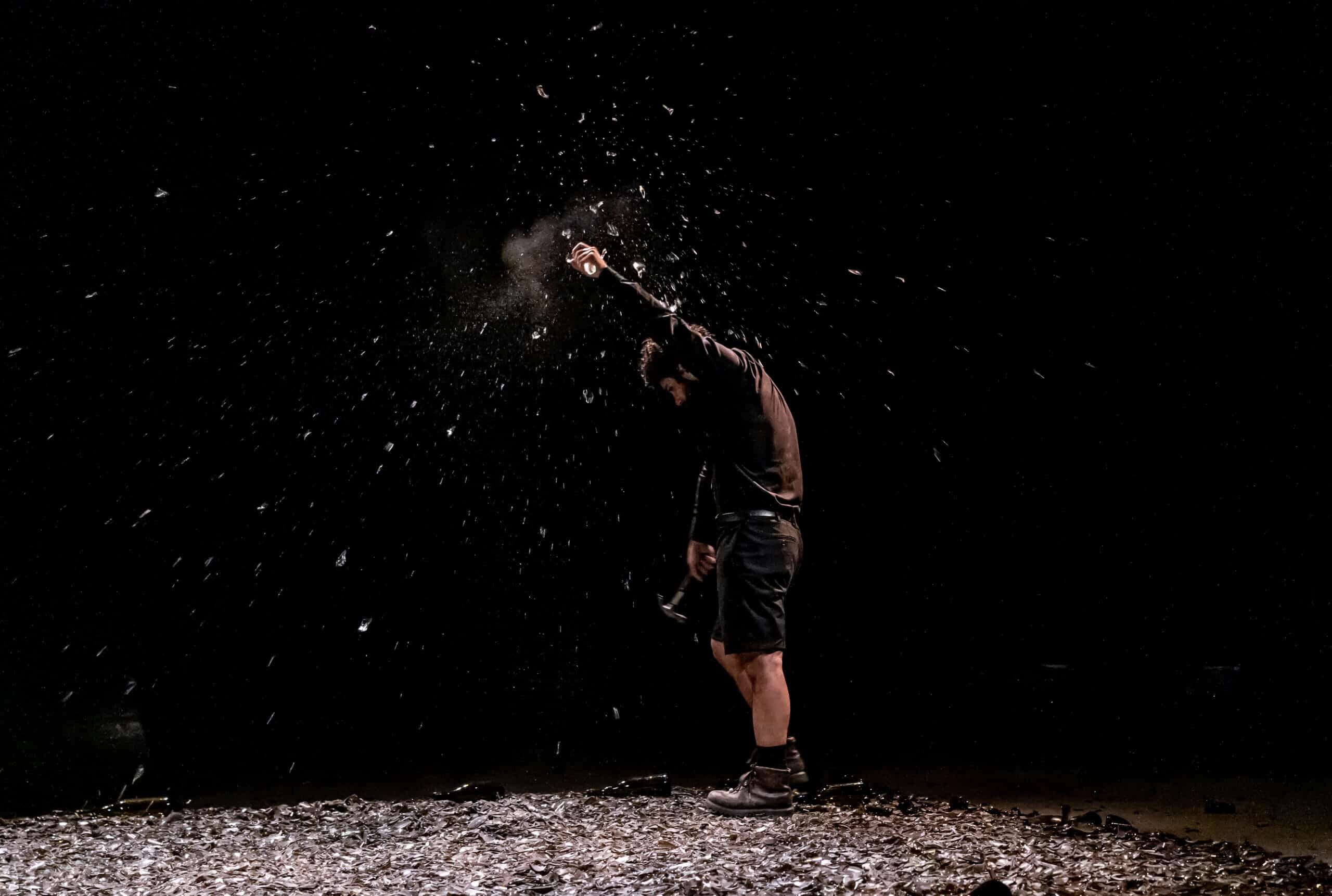
After finishing Le Lido, Silence Festival invited my personal project, Pacemaker, for a residency, and during that time, I developed a short outdoor piece called Hertz. The concept was to start with a provocation to take the audience out of their comfort zone. You see a character who provokes rather than speaks, and in that sense, it’s more a physical, rational piece than GHETTO, more of a performance than a show. In front of the audience, it is my inner clown who takes to the stage, smashes bottles and dances on them. It is a projection of injustice, driven by a desire to engage with society and say: ‘Listen, I’m here’.
After the collective experience with La Barque Acide, I felt the need to focus again on my own artistic approach, with the idea of working on a new solo piece, and I decided to submit the project to circusnext. In GHETTO, rather than the provocation of wanting to be seen, human vulnerability is brought into the spotlight; the clown connects with the audience to feel together. He embodies society’s problem. The jester, on the other hand, tells society that you are the problem. The show features both tendencies: pointing out the margins and empathising with those who live on the fringes.
No longer in an outdoor space, but in the darkness of a stage theatre, in GHETTO, the set design defines the character. Addiction takes shape within the space as an expression of marginalisation. The carpet of glass prompts you to wonder how many bottles there might be on it, how much one would have to drink to create such a vast carpet of shattered glass, and how long this person has been in this state.
The trapeze and fakirism are the two primary techniques that support the character in dialogue with himself. The phrases I repeat are from a poem by Fernando Pessoa, Poema do Menino Jesus, a hymn to the inner child. Its function is not narrative but rather linked to his oscillation between reality and delusion.

The practice of fakirism is painful, but it triggers a catharsis – in both the performer and the audience – centred on the acceptance of pain. What does practising this technique mean to you?
Macelo Nunes: Initially, the technical work was mainly aimed at training the ability to relate to pain and to move with lightness on the broken glass surface. I don’t feel pain on stage, even though the audience senses the danger I’m facing. There is an irrational, instinctive reaction to broken glass because you know it is dangerous.
What strikes me – and what I sense in the audience – is the contradictory revulsion and attraction when watching a fakir, the inability to avert the gaze, but also the ability to normalise what is happening on stage, because pain is present, yet so are delicacy and vulnerability, and this is why the audience eventually relaxes.
What is clear is that the audience is facing an unusual situation, what you might call transcending reality: the ability to empathise with the sight of suffering, to forget the pain and focus on the artist on stage.
In GHETTO, stage and sound design are key elements. How and with whom did you work on these aspects, and who else did you involve in the project?
Macelo Nunes: Everyone involved in this project is essential. I’m on stage alone, but GHETTO is the result of a team effort. I really enjoy working in a group, sharing and discussing ideas.
GHETTO deals with social exclusion, so the study on scenography was crucial to understanding where the character is situated. I wanted to create a surface made of broken glass, and this was made possible by the expertise of Lluc Castell, set designer for Baro d’evel. In the circusnext presentation, we didn’t use the full stage design yet, consisting of walls – concrete boundaries with which the protagonist interacts and which he cannot climb over.
The sound design by Joan Lavandeira – who is also responsible for the light design with Maria Papadopoulos – echoes this sense of emptiness and conveys the character’s disorientation. Initially, I had planned to propagate the sound throughout the venue from different points and distort it. Now it is amplified by a lone speaker on stage, a single, distant point, to reinforce the idea of isolation. Just as the scenography and sound design speak of solitude, the lighting also amplifies the sense of emptiness within the darkness.
GHETTO has involved various artistic collaborators to refine specific aspects of the research, including Rodrigo Portella for dramaturgy, Caroline Obin for the clown work, and Christophe Le Goff for the choreography.
Ezra Groenen, my teacher at Ésacto’ Lido, has accompanied me in my trapeze research. For me, there is no better person with whom to develop research on the apparatus in relation to emptiness; with her, you truly go beyond technique: you feel free, and anything is possible.
Someone extremely important to me and to the project is Löic Santiago, a teacher I met at Ésacto’ Lido and from whom I learnt the Russian martial art known as Systema, which focuses on stress points and the release of tension in the body. In this technique, the body receives and absorbs the impact of an external impulse, rather than reacting to it. We worked mostly on the suspended body on the trapeze, but applying the same concepts to the study of fakirism has allowed me to infuse dynamism into a technique that is traditionally more static.

How did the circusnext process influence GHETTO’s artistic creation?
Macelo Nunes: Being among the selected projects allowed me to be recognised as a circus creator and led me to found Cie Dissociée. Before taking part in the process, it was clear to me that I wanted to create spaces for reflection within culture through my art, but the selection pushed me to take a stand, to become a project lead and to define my needs and requirements as an artist.

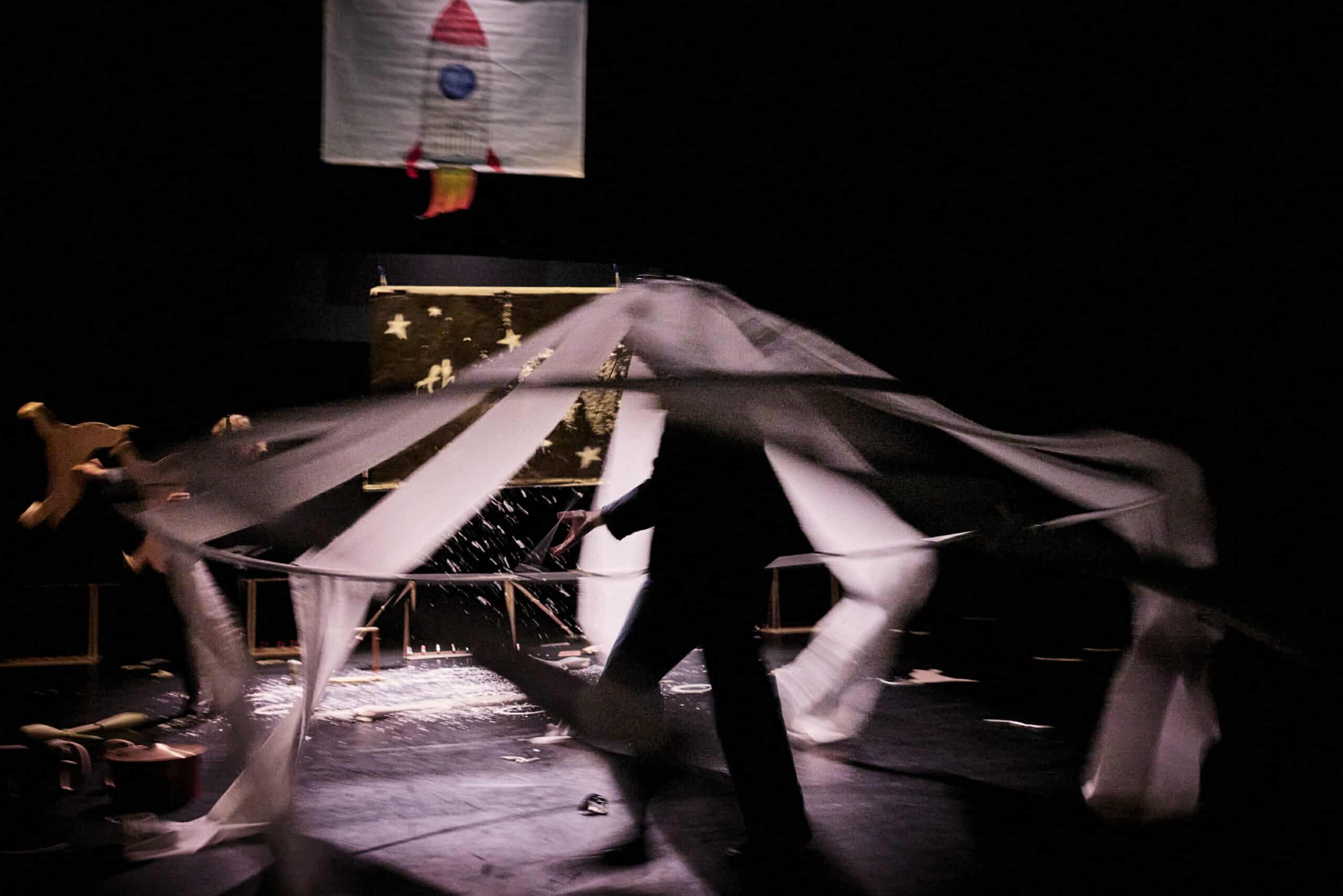

Jef David Martin’s Metaphoric Objects: the DIY fireworks of a modern troubadour
Around About Circus · By Valentina Barone
David Martin is a French author who pushes the boundaries of his juggling techniques. He is interested in creating what he calls poetic shocks with words and object manipulation, a synesthetic way of seeing props used while they inhabit the space. His parents, both astrophysicists, have been fascinated by juggling as a practice since he was a child. Juggling came naturally to him, but only later did he realise his vocation could become a profession. Studying at the preparatory circus school in Bagneux at Le Plus Petit Cirque du Monde, and later in Stockholm at SKH, his process of creation expanded into conceptualising, adding layers, ordinary objects, manipulations and combinations, prop-making, and inventions. While white clubs are still his main element, around this classical core, a contemporary world of layers and engineered props animates unseen, elaborated tricks or effects. Fascinated by medieval jugglers and their musical performances, he is passionate about circus history as an innovator who wants to continue this tradition. His research project, Metaphoric Objects, has now evolved into a show entitled Mechanics of a Dream Machine, which honours traditional circus, renewing the genre through object manipulation and humorous storytelling. For this circusnext interview series, I met the artist connected from Stockholm during one of the project’s residencies.
I know your mother taught you to juggle when you were 5. How is it to start juggling so young and growing with this ability?
David Martin: In Metaphoric Objects’ artistic dossier, there is a painting by my grandmother featuring me in my mother’s arms, while my hands are holding a green ball. So yes, I can say that juggling has been a part of my life since I can recall memories. My mother became fascinated by juggling after seeing Cirque Plume, and, as you might know, the company’s juggler Thierry André made the white clubs trendy. My parents often brought me to juggling events. At age 10 in Rennes, I saw Wes Peden playing at a convention, and I can say that this event deeply fascinated my way of perceiving juggling.
How did you start your intention of becoming a circus author?
David Martin: Before taking into consideration the idea of becoming a professional circus artist, I did university studies in multimedia and art history in Paris. At that time, it was just evident that I wanted to merge juggling with my studies. For example, in my final thesis, From Juggling to Digital Performances, I deconstructed the green contact ball featured in my grandmother’s painting, adding sensors to it, which already showed potential in seeing juggling as a multifaceted art form. I realised I was trying to create shows, and that meant I also needed to know how. I preferred a masterclass at La Maison des Jonglages to my autumn final exam, and this is how it all started. At 22, I entered the preparatory circus school Le Plus Petit Cirque du Monde in Bagneux, and later I pursued my degree in circus techniques at SKH, the school of my childhood hero, Wes Peden.

What is your way of creating juggling, and what does it mean to create through juggling for you?
David Martin: My relationship with juggling changed over time and brought me into a discovery modality I was unaware of through the practice of adding layers to juggling. Clubs are my main apparatus. My mother juggled clubs, Wes used clubs, and at that time, I was fascinated by the aesthetics of juggling as a composition with movement: that was the primary ambition when I joined the school. I arrived at SKH fully convinced to create beautiful pattern sequences with my white clubs, but it wasn’t happening, and I got stuck in my own doubts.
My juggling teacher, Ivar Heckscher – who is also the founder of SKH – told me to try getting engaged with my doubts in a specific range of time rather than giving them constant attention. I play with words and see concepts. It was there that, by writing “Doubt” on my white club and inventing “a daily tango with doubt”, this joke and approach were the first seeds of what is now Metaphorical Objects.
Jugglers in the last century were often engaged in creating their own props. At SKH, we also had a course dedicated to this theme with Erik Åberg. I wasn’t handy at all, but soon it became one of my practices, and I started building things. My routine was a daily studio session, a workshop, then a jump in the library to get some inspiration on what juggling used to be, and then I started to shift.
I also conceptualised my approaches, merging circus with fine arts and comparing a Kandinsky approach to juggling to a Magritte one. For me, at SKH, there is a Kandinsky approach to juggling, which means composing visual music with the standard juggling objects (ball, ring, club) and body movements, like visual music in painting, arranging colours, and shapes. This is somehow the juggling I’ve been taught, the classical standard approach, creating a sequence, choreographing body movements around objects. All the school’s graduation acts somehow showcase this conception of juggling. Benjamin Richter also opened the door to using any objects with his Language of Objects.
Magritte’s approach is conceptual and linked to familiar symbolic objects. I wanted to inspire my juggling approach with Magritte’s style of creating poetic shocks through surrealistic association, merging it with visual language and words. That’s why Metaphoric Objects explores a language linked to object manipulation that attempts to translate metaphors into physical form.
In the third year, SKH has a full semester dedicated to circus research, and I presented Metaphoric Objects in the form of an exhibition. This allowed my application to circusnext to create a show; without the process of participating in the selection, the project would not have existed concretely.

In the show, you blink at the traditional circus using shapes of tamed animals as props. What does this homage mean to you?
David Martin: During my studies, I dug into circus history because I am passionate about it. Through my work, I was interested in creating a tribute to classical circus and, at the same time, a joke, blinking at circus history rather than delivering a lecture on its rich past references. I am also fond of old circus props. For example, today, here with me, I have a star ring from Cirque Medrano from 1930. Metaphoric Objects has this ancient vibe, revisited through the contemporary lenses of my way of creating.
The show is also an attempt to discover the medieval juggler of today. There is a poem written around 1240 by the Occitan juggler Guiraut de Calanson listing all the skills that a juggler must have. One of them is to be able to play nine different instruments, compose rhymes, and jump into four hoops. So, in the show I want to present several of the cited juggler’s skills, bridging them with the essence of juggling, playfulness and musicality.
In a juggling book, I read that in traditional circus, the sea lions were considered the best jugglers in the animal kingdom. It’s from there that I took the idea of creating sea lion props that, in Metaphoric Objects, I animate by juggling with them while I am playing the accordion.
Even the show’s dramaturgy is structured as in a traditional circus show, and sequences are combined to create the full performance. On stage, we are three people juggling the space, making musical visual images. I was interested in exploring this kind of format because of its dream-like qualia: when you remember a dream, it comes to you in fragments rather than as a complete, long sequence.
What is your way of creating your objects, and how do your DIY props come to life?
David Martin: My DIY approach to creating props wants to revive an old sense of surprise, which is nowadays a bit less trendy, but which used to be the juggler’s practice. It’s the same as using fantasy to create images with simple resources. Object manipulation becomes a stage effect: I defined this effect as fairy juggling, in reference to the theatrical genre of fairy plays.
On stage, I use plywood, lots of balloons, tissue-paper confetti, cardboard, gaffer tape, a loop station, a fan, a cactus and a vacuum cleaner, mixing analogue with engineered props. Of course, it’s again somewhat about juggling and classical circus: in the show, I want to bring back Paul Cinquevalli, reproducing his act of juggling with water under an umbrella. My circular speaker looping the club’s beating is an homage to Philip Astley’s horses. The small tent structure is the symbol of the big top. In the voiceovers, I cite Jean-Michel Guy and Jani Nuutinen on the history of juggling, but everything is permeated with humour, and the sketches are in progress.
Who are your influences among artists that you can quote to define and locate your artistic research?
DM: The project is super rich in influences, going everywhere a bit, as a practice. I like to wander in art libraries and websites, exploring and making collections of various artworks, of various mediums and making connections. There is the field of the manipulators: the Language of Objects of Ben Richter, the poetic and musical tools of Atelier Lefeuvre-André, the craftsmanship of Johann Le Guillerm, the synesthetic juggling apparatus of Jorg Müller. There are also the balances and chain reactions of Fischli & Weiss, the anonymous sculptures of Roman Signer, and Calder’s Circus. There are the fragmentations, the « object as subject » writing and the Koulechov Effect applied to circus of the Collectif Mosjoukine for sure.

What is your relationship with the other artists on stage with you?
David Martin: Simon Malmsten and Mirco Morreale have both been my classmates at SKH. Simon is a flyer on the teeterboard, Mirco is a stage technician. They have always been involved in Metaphoric Objects since its beginning. They are somewhere between stage managers and performers, dealing with musical and visual images, but the juggling is all on me. They are also good at building props and inventing crazy solutions.
How did circusnext intersect with your creative project, and what impact have its activities had on it?
David Martin: Riga Cirks, one of the 25 platform members, is the oldest circus building in Europe. Presenting a work-in-progress there as part of a circusnext laboratory has been exciting because of the in-situ resonance between the traditional circus building and the scenes presented; it was a meeting between an old circus revisited and an interaction with the audience, contemporary as Metaphoric Objects is.
Broadening the view, circusnext validated my research, connecting the project with international partners to shape its final form. We are still in the process of sculpting the sequence of scenes that will compose the show, now titled Mechanics of a Dream Machine. We are going to premiere in the spring of 2027.
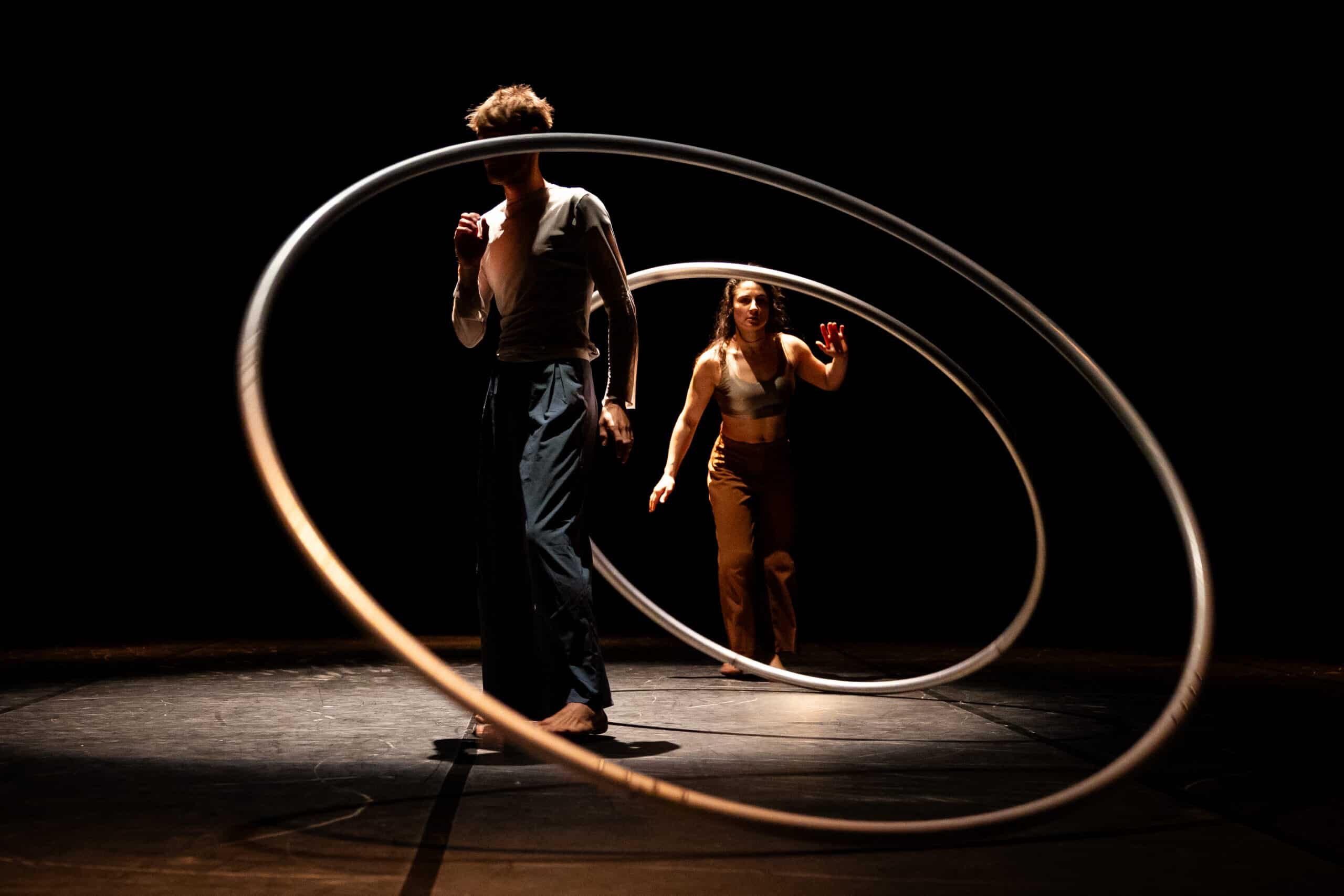

Jef and Marica’s In Difference: when the kinetic force of a contrast creates harmony.
Around About Circus · By Valentina Barone
Jef Everaert and Marica Marinoni have transformed their individual technical masteries into a common artistic creation. Both artists attended the same schools, first training at the Flic preparatory school in Turin, Italy, and then graduating from the CNAC in France, establishing themselves as two of the most interesting performers on the European Cyr Wheel scene. Their show In Difference explores how two opposite personalities can share common space and elicit a unique encounter with an apparatus. On stage, the two engage and clash in their search for common ground, with the wheel acting as a third character, fueling a dialogue based on physical, emotional, and human exchange. As gravity teaches us, balance is constantly in motion. In Difference embodies that tension, transforming it into communication. Drawing on the energetic momentum of a kinetic difference, two masterful techniques become a dance between distance and proximity, between stillness and extreme dynamism. For this circusnext interview series, I met the two artists in Turin on their Italian debut.
Let’s start with a key question. How did you meet?
Marica Marinoni: In contemporary circus, those who perform the Cyr wheel belong to a small community within an already niche genre. It’s a very close-knit circle! We both attended Flic circus school in Turin and met there, when Jef was still a student, and I was visiting. We graduated from CNAC three years apart, which isn’t long enough to create a real distance. With Juan Ignacio Tula, the author and founder of Cie 7 Bis, with whom I created my first solo piece, Lontano, in 2022, the generational gap is more evident. With Jef, however, I feel a more equal bond.
Jef Everaert: I started studying Cyr wheel at a Belgian secondary school, two years before joining Flic circus school, so the funny thing is that, despite a five-year age gap and three years of school in between, Marica and I have been practising Cyr wheel for the same amount of time.
What role did mentorship from dramaturgical aids and support from other organisations play in the development of the show?
Jef Everaert: When you start working as an author, it is essential to have people around you whom you trust. You need guidance, and especially at the beginning of a creative process, it is important to feel supported, to surround yourself with people who care about what you do and back you up. In Difference also stems from the decision to be supported by people with a similar approach, with whom we already had a relationship. For this reason, both Francesco Sgrò and Juan Ignatio Tula were subsequently involved in the work. As for knowing how to manage an artistic project, I, being in my first experience as an author, find that Marica is to me the mentor that those two were to her.
Marica Marinoni: In Difference is my second artistic project, but it’s my first experience as a co-creator and joint lead. In this collaboration, Jef and I are on equal grounds and make decisions together. We’ve always said that it takes two “yeses” to make something happen, and we stick to this principle. Today, we can say we’ve won our bet, whereas at the beginning we weren’t quite sure if or how we could work together. The project got off to an uncertain start, but thanks to a series of fortunate and amusing coincidences, it was immediately clear that we had to give it a go.
The first person to point out quite clearly that we should create something together was Francesco Sgrò. A full five years ago, almost as if seeing us work together was a foregone conclusion, a natural step that was bound to happen sooner or later.
The years passed, and we came to July 2022. Jef had just finished Les Échappées and had recently begun work on the year-end collective production. His personal project caught the attention of Cirq’onflex, which contacted him to hear more about his plans. Around the same time, I was on tour in Auch at Circa, performing my solo piece Lontano. We spoke, and from that moment on, it was obvious to both of us that we should take the first steps towards securing support for a joint project.
Jef Everaert: Thanks to Cirq’ônflex, in 2023, we had the opportunity to take part in three residencies, which we used as research workshops. Firstly, we gave ourselves the freedom to explore and experiment together without the pressure to produce anything, simply to see whether working together was actually a viable option. It was only in January 2024 that we began the creative process for the show.

In the meantime, you’ve decided to apply to circusnext. What motivated this decision?
Jef Everaert: Of course, we knew what the process involved and were already in touch with people who had taken part. We were certainly motivated by the thought that this would be Marica’s last chance, given that In Difference is her second solo project.
Marica Marinoni: The process drove us towards research and its evolution. Our ongoing interaction with the jury and the other participants challenged us and motivated us to identify aspects we hadn’t yet recognised. Building a narrative around our research and being able to articulate in words what we wanted to convey on stage was very helpful in better understanding which direction to take. Being represented with In Difference among the graduate projects is a huge recognition that has given us legitimacy and visibility. Above all, it has brought us into contact with countries where we had never previously performed individual projects.
In retrospect, I am glad I participated in a well-prepared manner, approaching the process with awareness to achieve artistic coherence. Crafting a bespoke presentation—not to be understood as a finished form—is an exercise in itself. Working on three fragmented scenes made sense for the dramaturgical coherence of the twenty minutes.
Although your work is conceptual, you are both highly physical artists who focus on technique. How did you come to establish your creative approach?
Marica Marinoni: At first, I found it very difficult to explain the personal exploration of our relationship on stage. Some people didn’t understand what we were trying to communicate through the technique. They saw the movements, but not their meaning. Personal expression and technical exploration coexist in both of us in a very similar way, and it took a while to bring this quality into focus. Talking about our project often felt reductive to me, whereas performing it in front of an audience always led to more intense reactions. Even today, I find it difficult to put into words what the show conveys on stage.
If we were to talk about a triangle of values between you and the wheel: what does the Cyr Wheel mean to you, and what is your relationship with it?
Marica Marinoni: Through the Cyr wheel, I’m able to express who I am and what I want to say: I’d struggle to communicate in any other way. I find that offering your body on stage is an act of generosity, a moment when you give yourself to others, evoking emotions in those watching you.
Jef Everaert: Although we had the same teachers and shared the same working methods, it is clear that we have a completely different approach to the apparatus. Marica speaks more from an instinctive point of view and has a more emotional and dynamic approach to technique. For her, the wheel is at the service of the body. I am more reflective and approach the wheel as an object manipulator would, because I come from a juggling background. My insights stem from reflections on how the wheel moves, rather than from a movement and its reaction. I put my body at the service of the object: with my body, I try to make the object do things, rather than having the object make my body do things.
Marica Marinoni: In other words, I use the wheel and gravity to make my body appear to be flying, while Jef uses anti-gravity to suspend the wheel in space-time.
Jef Everaert: Even if I can identify myself strongly with this state of stillness, for me, interacting with the wheel is not just about balance. During Flic and CNAC, I began observing other artists, particularly jugglers, asking myself what I particularly liked about their technique and how it might influence my own. Manipulation, balance, and contact were already the basis of the things I worked on. One day, I saw Marianna De Sanctis during an improvisation with the hula hoop, and realised that the same movement and the resulting balance of the object on the body could also work with the Cyr wheel. A contemplative imagery immediately opened up to me, in stark contrast to what one usually expects from its use. It was like gaining access to a new physical vocabulary and concepts that I could bring to the stage.
What led you to discover the creative journey of In Difference?
Marica Marinoni: Our collaboration stemmed from our shared passion for the Cyr wheel itself, combined with a deep mutual respect. Having seen Jef’s solo project, the initial idea was to revisit the setting he had devised for his project and see how we felt working together there, because at first it seemed to us that there was room for both of us. Yet, the further we progressed in the process of creating the show, the more we realised that Jef’s setting was a false lead. The tree on stage, for example, was very limiting; it belonged more to him than to me, and in this we were not equal. Its presence prevented us from creating something from scratch, something that was entirely ours but built from a starting point of equal possibilities.
Jef Everaert: We needed to start with a blank page that belonged to both of us. Now, the balance we’ve found for In Difference is all the materials we’ve worked on together from the very beginning. Adding dynamism and stillness to both of our individual practices has allowed us to push our individual research further and turn it into shared ground. We wanted to go beyond our technical limits and amplify them through our relationship with one another. The performance has this quality: it creates osmosis within difference and individuality within shared ground.

Which other artists have been involved in this project?
Jef Everaert: Francesco Sgrò, who also composed the music, was one of the first people we brought on board as an artistic collaborator in the broadest sense. The decision to work with him felt natural because he already knew us well and understood how to deal with our different approaches, personalities and needs.
Marica Marinoni: We also brought in Juan Ignatio Tula, primarily to work on the physical material, and involved Alexander Vantournhout for the overall dramaturgy, who helped us confirm the order of the scenes to achieve a conceptual and sensitive result.
Jef Everaert: When you learn a basic move and perform it repeatedly, the magic of doing it fades, yet the surprise remains for those watching. Some things seemed ordinary to us, but they aren’t to the audience. Sometimes you need someone outside your circus know-how to see you perform and help you understand what you’re trying to express in a narrative sense.
Marica Marinoni: Where a simple rotation might seem superfluous to us, it is at that very moment that the audience breathes a sigh of relief and the energy rises. From a dramaturg’s perspective, the attempt to balance on the wheel together highlights our desire to connect with one another and our failure to do so. A simple movement is important because it also represents the first step in a variation; it is the first element of a technical language that you will see evolve. This is why it seemed right to us to involve people from outside the circus world, such as Marie Ballet and Guillaume Servely, to make our language accessible even to those unfamiliar with the circus and the Cyr wheel as such.
How did the circusnext workshop support your creative process?
Jef Everaert: We participated in the workshop in Serbia run by Cirkobalkana, and the experience gave us the chance to work in a way that was less technical but more focused on understanding what we wanted to express on stage. Working together during that workshop gave us a new sense of depth.
Marica Marinoni: It made us aware of what we have in common, as well as our differences. This is extremely valuable because when you want to address diversity, you have to look at it from every angle, including its opposite: togetherness.
Since the beginning, the technical side was already there, we’d got the hang of it, and everything was going well, but the bond between us came later. At the start, there was a sense of osmosis, which then expanded thanks to a slow process that allowed us to focus on one another. It was as if we were technically too close to be able to see our differences. The creative process taught us that getting to know one another is not a given, nor is discovering how and in what we are different.
Your stage presence is like a statement of personality without a specific character. Yet the natural contrast in character comes across powerfully through your stage movements. What challenges have you faced in developing your artistic partnership, and what have you learnt about yourselves, both as performers and as people?
Jef Everaert: On stage, it’s just the two of us as circus performers. We don’t play characters: it’s as if we were just ourselves, only a bit more exaggerated.
Marica Marinoni: I laugh because my sister, for example, gets annoyed when she sees me on stage, because to her I’m very much like my real-life self on stage; she says I’m predictable, that she recognises me as a person.
Jef Everaert: Before I got started on this project, I used to work with people who had a similar creative approach, whereas Marica and I work differently.
Marica Marinoni: For me, there’s always a creative quality in facing something unfamiliar. For Jef, conflict is a shock, and he avoids it at all costs. Yet the theme of difference originated with him and has enriched the project enormously. We had an idea for the show, and we relaxed rather than trying to dominate the other or impose our egos. Let’s say we worked towards a collapse of the ego for the greater good. From Jef, I learnt humanity. I realised that sometimes, by remaining kind to people, things evolve and often resolve themselves. And then I saw that every conflict made us grow; there was always a marked improvement; confrontation became our strength.
Jef Everaert: Everyone who knows us individually is now surprised when they see us on stage and tells us that we look more alike. I am now more like Marica in the way I perform, and Marica is more like me. For me, this means being more in touch with the pure movement and the world of abstract choreography; for her, it means being more in contact and exploring the potential for humour and theatrical play. For both of us, the project represents the freedom to explore many styles and experience a human connection. From Marica, I’ve learnt that if you want something, you have to go and get it, and that sometimes you can be more persistent, stand up for yourself a bit more, not accept things you don’t want to accept, stay in the process, take care of things, and be more active and practical about the things that need to be done. We’ve both learned how to be project leaders together.
What plans do you have in the making for the future?
Marica Marinoni: We are a duo collaborating on an artistic project, but we have maintained our individual identities whilst working together, without setting up a company. We want to take the project on tour as much as possible. In Difference is currently our priority. From my experience, I know it is entirely feasible to make room for other individual projects as well, which will undoubtedly enrich our stage presence.
Jef Everaert: Given that the performance draws on a very broad artistic vocabulary, we can extract specific sequences, which allows us to be flexible and experiment. We want to work with a live musician and create an outdoor, site-specific version of the project. It will be interesting to develop a format suited to a site that is different each time, an aspect that will undoubtedly enable us to expand our artistic language even further.


Jef Everaert & Marica Marinoni (France)
In Difference
David Martin (Suède)
Metaphoric Objects
Cie Inéluctable (France)
CE(UX) QUI RESTE(NT)
Cie Dissociée (France)
GHETTO
© Christophe Raynaud de Lage
Roue Cyr · Création : octobre 2025
Deux interprètes, deux roues Cyr, deux styles distincts : Jef est pacifiste et indécis, Marica est convaincue et conflictuelle. Guidés par leurs contrastes, les deux acrobates tissent un dialogue poétique et physique où convergent le conflit et la complicité. In Difference est un périple vers une rupture progressive des usages de la roue Cyr, allant jusqu’à la rendre vivante.
Marica Marinoni, née à Milan en 1995, et Jef Everaert, né à Louvain en 1999, sont des artistes de cirque spécialisés dans la roue Cyr. Tous deux ont étudié à l’école FLIC à Turin et au CNAC en France. Ils développent des approches uniques : Marica explore la fluidité et l’acrobatie dans le mouvement, Jef s’appuie sur sa formation en jonglerie pour innover dans la manipulation.
© Christophe Raynaud de Lage
Jonglage · Création envisagée : fin 2026, début 2027
Projet de recherche, Metaphoric Objects est une collection d’expériences artistiques menées par un jongleur touche à tout, en quête d’un langage poétique à travers la manipulation d’objets. Hors des formats traditionnels, la performance se décline sous de multiples formes, au gré des apparitions de l’artiste et de la collection présentée.
David Martin naît en région parisienne. Après des études dans les arts visuels et médias, il se forme au Plus petit cirque du monde à Bagneux puis à Doch à Stockholm.
© Christophe Raynaud de Lage
Acrobaties au sol, marionnettes · Création : octobre 2026
Touchés par une perte commune, Marius Fouilland et Aimé Rauzier s’unissent dans une pièce qui interroge notre rapport à la mort et le conjugue au présent. Guidés par le langage acrobatique, ils donnent corps aux absent·es : marionnettes et humains se confondent dans un dialogue entre deux mondes. Sauter, s’élever, basculer, chuter à deux, se relever à quatre.
Marius Fouilland et Aimé Rauzier se forment aux acrobaties au sol à l’Académie Fratellini. Aimé travaille comme interprète dans L’absolu pour la Cie les choses de rien et Foraine avec la Cie Bal. Marius a travaillé en tant qu’interprète avec la compagnie Samuel Mathieu pour la création de Saltarines. Il fonde la Compagnie Inéluctable en 2022.
© Christophe Raynaud de Lage
Fakir, clown, trapèze statique · Création envisagée : 2026
GHETTO met en scène l’addiction comme un serpent silencieux, emprisonnant son personnage dans une boucle infernale où chaque moment de plaisir se transforme en désespoir. De ce contraste entre illusion et réalité émerge progressivement une lueur d’espoir, une guérison rendue possible par toute la force contenue dans la souffrance, la résilience.

© Christophe Raynaud de Lage – Noa Aubry

En partenariat avec

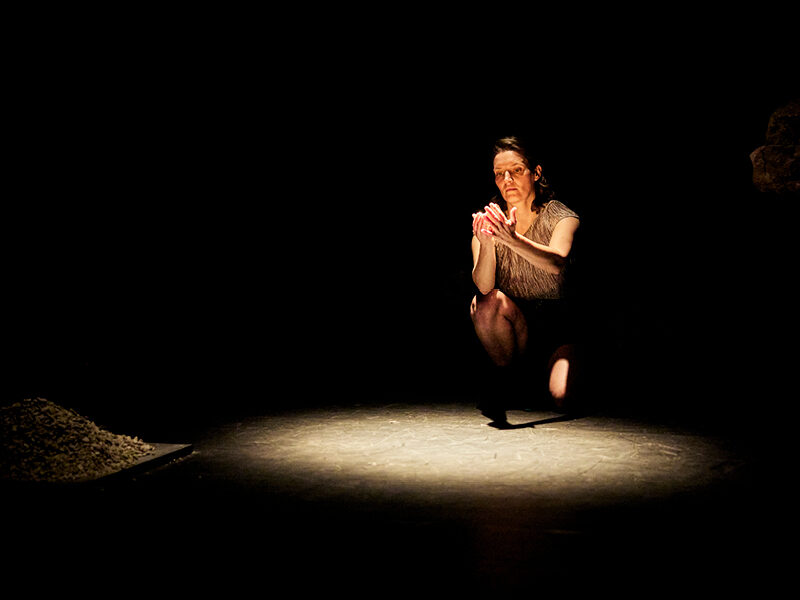
INTERVIEW. Maison Courbe, Le Bruit des Pierres – En collaboration avec Around About Circus

Le Bruit des Pierres by Maison Courbe: for a necessary ecology through the live arts. By Valentina Barone.
How can we heal our complicated relationship with matter? From the presence of stones, we could learn the humility of serving the living, without being bothered by the passing of time. In Le Bruit des Pierres – which we can translate as The Sound of Stones – circus and visual arts blend. Pebbles, rocks, and crystals become partners and suspension apparatus. Chalk underlines gesture and space while edible crystals crunch, and percussive stones fill the sound space as scenographic and dramaturgical elements. For this circusnext series of interviews, we engaged with part of Maison Courbe, a French collective supporting the fascinating creation process of a show connecting France and Brazil. In a conversation with the three co-authors; the visual artist Domitille Martin, the circus performer Nina Harper and the performing artist-researcher Ricardo Cabral, we discover more about their performance and understand that collapsing and suspended sculptures can co-exist on stage as living matters. In 2022, the project won the Croisements / Cruzamentos programme, a research residencies path in Brazil and France for artists of the two countries. Two years later, the trio is one of the circusnext laureates ready to debut at the TMG – Grenoble on the 13 and 14 of March 2025.
Valentina Barone: Before talking of Le Bruit des Pierres, could you give me a glimpse of Maison Courbe as a collective?
Nina Harper: Maison Courbe is a collective structure created in 2021 to support the artistic projects of Inbal Ben Haim, Léo Manipoud, Nina Harper, Domitille Martin and Kamma Rosenbeck. As young artists with circus and visual arts backgrounds, we met on shows combining different languages (with Cie Libertivore, Cie l’Attraction and IDEM Collectif, among others), and decided to build this shared house to host our projects.
Sometimes, it is necessary to be together to discuss ideas, support, confront, and help each other during our singular experiences. A mutual structure allows you to mutualise funding and share reflections on creating something together, but that can grow in different directions. We also care about the mental health conditions around artistic creation and think about how to bring more joy and health inside the career of a circus artist, an aspect which is not on the spot and easy to deal with all the time. These factors connect us and are similarly visible in our pieces.
We have been close friends for a long time, and were at a similar point in our careers: we wanted to manage our projects directly but did not want to create a single company for each of us. Maison Courbe represents a landing point, a common base in Grenoble, where we are associate artists at the TMG – Grenoble.
Domitille Martin: We share the same values and a similar attitude to aesthetics in mixing live and visual arts, with a vivid curiosity around installation and ecological sustainability while touring. We are currently working on three diverse projects. Sometimes, we collaborate for workshops, ateliers, or carte blanche, because the transmission aspect is also pivotal to us. At the core, there is a specific interest in questioning how to heal the relationship between humans and natural matter.
There is a palpable link between what we create and what we care about. And I think it’s just really connected to the environment, with the situation we are in as a species, and reconnecting with nature and being part of something. It also intuitively presents the idea of merging personal and planetary caring. This aspect is part of our message and what we are trying to say.
The collective house can have different branches, and in that sense, it is a rhizomatic structure able to adapt or extend its limit to include other people for various projects. It is an open structure with fixed artists who invite others to participate. For Le Bruit des Pierres the authorial team includes Ricardo as an invited artist.
VB: What are the origins of Le Bruit des Pierres, how did the three of you meet and start to collaborate on this project?
Nina Harper: Domitille and I met for the first time in 2015 in Paris, while I was at the Académie Fratellini and she was studying decorative arts. We started to spend some time in the studio together to research how to suspend Domitille’s sculptures, and how I could interact with these spaces and transform them through my interaction. Domitille had previously spent a year living in Brazil for a school exchange and I was born in Brazil, so even at the beginning of our friendship, the natural element, the presence of nature, the tropical forest, was already there. Brazil is a very specific place. It gave us the impulse to make things happen. It is a country with strong contradictions, it has had a huge impact on our lives. It has such an amazing and strong nature and, is also, a geo-political and economic place with such strong contradictions that have a lot of impact on our lives and this work. When we met, we started to suspend her installations, and I went to transform this space. Hanging on different, unusual support was very liberating for me. I admire artists who work for a long time to develop their own vocabulary in a single apparatus, but I never really enjoyed spending years and years trying to find different figures using that same one.
So, it was very satisfying for me to open up and work with different supports. We were already attracted by natural elements, working with plants, stones, ropes, plastic… any kind of material. During one laboratory we suspended the stones, noticing that we were touched by the image of strong objects suspended with thin ropes. The contrast of the heaviness with the light suspension was intriguing and reminded us of the principle of the Damocles sword, a very threatened object which can fall at any time. As a symbol, it was very powerful, and we started to notice how impressive it was to lie under it because it looked like it was hanging in such a fragile way.
As suspended apparatus, I found stones incredibly interesting. Since they are not aerial tissues or ropes which can be adapted to your body, the principle is the opposite, it is always you who has to find a way to adapt. They are not going to change, you can’t break them, or force them to do whatever you want, you are obliged to respect their shapes as they are, with their strongness, their weight, their relief. Every stone is different from another, and even on the ground, dancing with them, and feeling their weight, there were aspects that instantly engaged my body to collaborate.
Domitille Martin: Among all the materials we found, the strongest image we kept in mind was the suspended stones. It was a starting point, that crucial moment of the instant just before a fall in which we can imagine many stories. Many years later, we decided to apply to the Croisements / Cruzamentos in 2022, a research residency programme in Brazil and France. Ricardo and Nina already knew each other. We were selected, and that allowed us to continue our research. Thanks to this application, we had two months of residency, one in Brazil and one in France. It was the perfect opportunity to meet again.
VB: Ricardo, what is your role in the team, and how did your adventure inside this artistic process start?
Ricardo Cabral: Nina and I have been in contact for more than ten years, and because of this double residency programme between Grenoble and Rio de Janeiro, we reconnected to work together. At that time, I was at the beginning of my PhD at the Universidade Federal do Rio de Janeiro, and my research was exploring how performing arts can collaborate with collective organisations and ecosystems in order to proliferate more life while the sky is falling. This concept is dear to us as expressed in the book The Falling Sky, written by the Amazon indigenous shaman Davi Kopenawa, from the Yanomami people, together with a French anthropologist with whom he has had a friendship for over thirty years, Bruce Albert.
At the beginning of our artistic trajectory, we were asking ourselves basic but relevant questions. How are humans different from stones, and how can we perceive stones as forms of living, as minerals are fundamental components for the whole ecosystem? Through the differences between humans and stones, what can we do together? If we engage in a physical relationship with them, what can we learn about our way of being human? The pivotal point was mostly the idea to start creating relationships with other forms of living.
In the intricate and fascinating Yanomami cosmology, there is a correspondence between what lives above us, the sky, and the minerals deeply rooted in the ground. The sky above our heads is anchored on the earth by huge mineral structures.
So if we continue to tear up the ground to extract copper, petrol, silver, or whatever mineral we want to use and sell, we are damaging the structures of our planet. That’s what we have been doing historically for centuries, and once the sky falls, we are all going to die.
This idea influenced our creation deeply. Suddenly, stones and minerals were no longer immobile still-life objects with business value; they were not unanimated things anymore. Their silent presence became incredibly powerful. This principle caught our attention and helped us understand the significance of suspending stones in the air.
Le Bruit des Pierres is about collaborating with stones to experiment a poetical and political human-mineral alliance. Which relations to rocks may we imagine, beyond mining for precious gems or exploiting mountains for microelectronics?
VB: Nina, as a circus performer, what did you discover from creating the interaction with the stones as apparatus?
Nina Harper: For me, circus is a place where you can experience a state of metamorphosis and create a dialogue, a way to get closer to nature, to empathise with flat hierarchies and other bodies, animals, matter, not-so-vertical hierarchies, or non-binary bodies.
I’m still discovering how circus through this practice is shaping my gestures and choreography. Working with big stones made me ask myself how far I could go and how much weight to take. It is a balance of responsibility. In one scene, I let this giant stone roll on my chest, and it was interesting to figure out how much I needed to go against it, to protect myself, and how much I needed to give in to its weight. You need to find a balance to be able to move with it. Stones taught me a lot about humbleness. I live the danger disseminated on stage as a game to play, a challenge to realize how far I can adapt, control or release control.
During our last residency, this was our main paradoxical question: since we created a space that asks for a lot of adaptation, how can we get rid of the sensation of feeling blocked by the stones’ presence? If you think about it, this is a perfect metaphor for the world we are living in. We feel blocked because we need to create innovative ways of being in connection. On the other hand, being able to control the risk is one of the main principles of circus, and at the same time you want to give place to the unknown, it is always a thin negotiation, especially while working with stones as apparatus.
VB: Scenographically speaking, the stage space seems like an extended moving sculpture placed in front of the audience. How did the rigging element come in, and what has been its influence while shaping your show?
Domitille Martin: The main principle with the rigging is to keep visible the relationship between the air and the ground. To recreate the relation between the ground and the sky, we hung stones with ropes to the theatre grill and other big ones on the ground with thin ropes. This correspondence creates an interdependent ecosystem because if you alter the position of a stone connected to the ceiling, you affect another one on the ground. You don’t know how you feel in an unstable environment, capable of falling without knowing exactly when. In the creation, we discovered that the falling of stones was as curious as their suspension and decided to show this moment of collapsing and destruction.
Resonating with the residency places has been very useful. In Brazil, the energy of a dismantled theatre where we could let rocks fall on the ground resulted in creativity for our scenographic research. The piece speaks about suspension and collapsing: there is something about being on the ground, falling and being suspended, as a reflection of the relationship Nina and I have, she as a performer, me as a visual artist.
On stage we don’t want to hide all the techniques involved and show only the magical element. Our use of the materials is very raw, we use real stones, and we show the ropes. We suspend and move the stones using their movement to produce sounds. We want to communicate their qualities by revealing some technical aspects, but not all of them. On the contrary, you can also see very weird things happening, because we have rocks you can eat, and others that look heavier or lighter than you think. There is a little bit of a distortion in our proposition.
Ricardo Cabral: At the beginning, we attempted to work with local stones at each performance and then take them back to where we had found them, but then we realised it was too complicated for Nina to adapt her movements and even for our scenography. Since our creation is centred on revealing the relationship between humans and stones and started as an immersive performance, it feels relevant to mention that in an earlier stage, the environment welcoming the audience was one without any separation between the stage and the public. We then gave up on this immersive structure since we understood that the audience could feel the stones’ presence, even without touching them.
Nina Harper: We decided to go back to a black box format and created distance between the audience and the stones to facilitate the rigging suspension in different venues. This separation raises the perception of risk and the fragile quality of each suspension while, at the same time, allowing us to protect the spectators. It was too dangerous to position people under the suspended rocks.
VB: At what point in your creative process did you engage with the possibility of applying for circusnext?
Domitille Martin: It happened at the beginning of our activities as Maison Courbe. We researched for two months and started working on the piece after only three weeks of writing. For Le Bruit des Pierres, circusnext has been a new beginning. Being selected happened with great timing. Going into creation mode with a concrete proposition and a deadline helps you not get lost.
The team of circusnext is hearty. I love their way of being involved in circus and how they get engaged with the artists. We met many other artists from other countries, and it was enriching to share what we were constructing for the show and to test it. This moment of visibility was great for us. We had the opportunity to share a piece of the show and felt strongly supported.
Ricardo Cabral: When applying to circusnext, we were aware that we had a bold and scary proposition. Imagine writing that your first project is an international collaboration involving 500 kilos of stones and their transportation! So, circusnext is actually the kind of label that supports bold projects, even when unknown, because they see the potential of your idea. It was a big bet, but we used it to keep going.
VB: Who are the collaborators helping you in developing the show?
Nina Harper: We had some people in specific moments helping us as a mirror, and that was also interesting because we got involved with very different aesthetics. We worked with Tristan Garcia as a dramaturgical advisor, Fragan Gehlker and Léo Manipoud, who come from circus, and Gaël Santisteva, more physical theatre and performance, as artistic advisors, and Sandra Ancelot, from the visual arts. She helped us develop the presence of Domitille, who has a different kind of body, presence, and gestures than a circus performer. It has been helpful to receive the help of someone sensitive to defy and value these differences.
Martin Domitille: The show contains a big mix of different sounds, natural sound compositions and pre-recorded sounds on stage before the performance. The music is by Nova Materia, a Chilean-French duo from Paris experimenting with soundscapes from natural materials like stones. They came to visit during some residencies, recorded Nina’s movements and interactions with various props in their atelièr, and composed the tracks. Recently, another sound designer, Timothée Langlois, has been helping us with pre-recording the ambient stage sounds used during the performance. What is important for us is to create a good balance between the sounds from the stage you can hear live and the pre-recorded ones.
VB: What’s next and what are you learning from Le Bruit des Pierres?
Nina Harper: We are dealing with an exciting time! We finished a residency at La Cascade to write the main lines of the piece, add the details of each scene, and work with the lighting designer Marie Sol Kim. Ricardo is also coming from Brazil to finalise the piece with us and our première is at the TMG – Grenoble in the middle of March.
Ricardo Cabral: There is something incredibly satisfying that we have been doing these last two years, and that is learning how to work together as co-authors. In theatre – where I come from, usually only one person is directing. Co-creating is not easy, it needs time and discussions, like carrying stones, you can’t be just by yourself. And I do not take it for granted. I think we have learned how to do it, using the energy to take us in the right direction, and this is the expertise I am proud of and something I’m taking from this experience with me into every future project.
INTERVIEW. Noa Aubry – Là où la nuit n’est pas si loin puisque le jour s’en va déjà – En collaboration avec Around About Circus

The poetic spatial dimension of Noa Aubry. By Valentina Barone.
Noa Aubry is a French circus author interested in pushing forward the technique of the German wheel. Studying circus since she was an adolescent and then at a professional level at CNAC, she ended the trajectory of the circusnext process presenting a powerful and delicate solo with a long provocative French title, Là où la nuit n’est pas si loin puisque le jour s’en va deja. Noa’s personality finds her expression in the constantly shifting limits, where space and time coordinates meet each other and balance a dance of interlinked contrasts. Her technique of listening to the apparatus as it reacts to her movements redefines the mastery of controlling the object. In her solo, the German wheel becomes a space of being, a 360 bubble in motion responsive to weight control. For this article in the circusnext interviews series, we move at the intersection of reflective thoughts and embodied practices, looking at how she is shaping a personal artistic way of using an uncommon circus apparatus from gymnastics.
Valentina Barone: When I think of the German wheel, in terms of versatility, I feel hesitant. How did you get passionate about this specific equipment, and why?
Noa Aubry: I started studying circus when I was fifteen at ENACR. I took multidisciplinary classes, but then my teacher introduced me to the German wheel, and I immediately liked it. At school, I rarely saw any representation of it and was unaware of its potential. As everyone does nowadays to learn the technique, I spent a lot of time watching videos of acts or gymnastic competitions and all the possible materials I could find.
Intuitively, I thought, there might be a space of freedom for me to learn in my way and at my own pace. I have a background as a musician since I played classical guitar for a long time, which gave me a musical approach to circus and developed a very precious relationship with rhythm.
While doing the German wheel, no matter what I was learning, it became evident that the rhythm was always the same. There was always a systemic momentum following the same pattern: an acceleration, a figure at the top in suspension, an acceleration, a deceleration, and, again, a suspension. I wondered if, instead of learning a new figure and focusing on what to do inside, we could look further at the wheel movements and open up other possibilities. I began to explore that aspect and went back to the basics where I could have control and master the wheel’s weight.
Later on, I continued exploring the German wheel at CNAC. Since my research relies on weight shifts, I focused on slowness, not directly, but as a consequence. My research is entirely about paying attention to the details of how the weight moves. How can I hold onto it, have the time to absorb the wheel movement, and not just think about when to insert a figure at the right moment? I had to stop thinking of circus figures in favour of listening to how to move this wheel and to receive the wheel movements. I like geometry, and this apparatus evokes it, creating curves and connections between lines and spirals. In my approach, it is my body that moves the wheel, not doing feats, just as a body that can exist within that object.
For me, the question is: what does my body feel? We are alive, feel something, and are unique in our feelings. How do I touch the wheel, and how does my body position itself? In circus, we learn figures, so it’s very likely we end up doing similar things. This research is a way to say that I can be different and maintain my individuality in this discipline. The more we feel, the more we notice details, and the more time seems to stretch. When there is slowness, I can feel the entire journey of the sensation through my body, it slows down. It intensifies.
VB: Your work merges the dimensions of space and time. Is the German wheel a space for you rather than an apparatus?
NA: Yes, it is more about a space than an object. I also work on presenting the body in a way that doesn’t immediately change when outside of the wheel or without it. The show does not aim to symbolise something in the wheel or something outside of it. It is more like a journey, a sensitive exploration. The German wheel exists on its own. I can exist inside of it and move on it. The weight of the German wheel is almost similar to mine, around 40 kilograms. And yet, I wanted it to feel light, to make it appear light. I wanted to express a sense of softness through a sensitive approach to this apparatus.
When the audience enters I am already on stage but not yet inside the wheel. We spent a lot of time thinking about how we could emphasize the body and not just the body-with-the-wheel. For this reason, setting up the space on stage and inside the wheel are both delicate moments. I enter the scene and only go inside the wheel after many minutes. The wheel’s space offers possibilities of rhythm and suspension, conditioning my body in specific ways at certain moments. If I resist the wheel, movements can be very slow, but there might be faster moments. I always work on alternation, seeing how my body is with and without the wheel. But the importance for me is that the body keeps traces of these spaces inside and outside the wheel so that there is always a continuity of the body.
The wheel is a space that carries my body, as the ground carries the wheel, but the wheel is all around me, so there’s a dimension where I’m both suspended and grounded. The wheel can be still, and I can move inside it, or I can be still, and the wheel can move. All these exchanges are very diverse.
VB: At what point in your career did you apply for circusnext?
NA: I was just out of CNAC and wanted to create a show as my research’s continuation. It took some time before it grew into a form that could become a whole show. Applying for circusnext was not necessarily in my thoughts, but people recommended doing it and I applied with the material I had researched in school. I enjoy reflecting on creation. I can spend a lot of time writing and reading to try to understand. The philosophical and intellectual dimensions interest me and nourish my work as something I need. The first lab during circusnext was great because it was just before my first residency. It was nourishing to be with others at the beginning of the process and exchange ideas, to see people who understand what you want to do. Circusnext was great for setting milestones, and artistically it gave me reference points that enriched the process. It also helped me find a team, someone for sound and lights. Often, these things work last minute, but it changes everything when there are suddenly lights and sounds, and in my case, I am happy to have done some of that work in advance. I reminded myself I wanted to explore more after the process ended. The show is not finished yet. It is still a sensitive work on transformation.
VB: Can you tell me more about your choice of an intriguing title as Là où la nuit n’est pas si loin puisque le jour s’en va deja?
NA: I chose the title quite quickly; it came up almost as an intuition. There’s a poetic approach in the title that I wanted to evoke. I sometimes like to provoke, in the fact that it’s a bit long. I love that moment of transition between day and night. The basic idea was to let it express a place where something is happening, an in-between space, a place of passage. What’s relevant for me is just the transition. At what point do we draw boundaries? When do we decide that it’s night, and what happens in between? This research is much about that. Our entire life is compartmentalised. All words describe specific things, and there are boxes, borders, and edges for everything. But in reality, things are never as defined as that. As humans, we often decide to define, although everything is transforming, and we always carry the past we’ve lived through and the projection of the future. There’s always a permanent temporal multiplicity. I wonder how to make these in-between spaces sensitive.
VB: Who is behind the scenes with you and helps you professionally during creation?
NA: I worked alone a lot at school, but since I started the show, I’ve understood how enriching it is to work with other people. I work with Naïf Production, a company based in Avignon. I met Mathieu Desseigne-Ravel, one of the founders, during my time at CNAC. He had already supported me during Les Échappées, the presentation of solo research I did at the end of the three years of training. There was already a powerful artistic and human connection, so I asked him if his company could support the project and provide feedback and human exchange throughout the creation process. Other people support me, coming in occasionally to help me understand the research. It is important for me to discuss and compare my ideas with other people, it enriches the creation a lot, especially for a solo.
VB: How did you arrive at the choice of implementing the pulsing mixture of electroacoustic sound composition?
NA: I composed the first musical ideas myself. At that time, I needed to use music to express what I felt, but then I realised that I already had enough to do on stage and could let go. Now, I work with Christophe Ruetsch, a performer and composer who works with all kinds of sounds, which he casually mixes on stage or in electroacoustic music studios. He brings me new intuitions, possibilities that I did not necessarily imagine. It has been a very enriching encounter that makes the process grow.
VB: What are your influences or inspirations from the arts that you bring into your circus research?
NA: I love going for walks and looking at landscapes. Sometimes, I take time to observe something like a river with a current. The river moves, and just behind it, there are trees. If there’s wind, the leaves will move, but the tree trunk doesn’t. In the same landscape, we have these different rhythms coexisting and also, the weight of the elements that surrender to the wind, or not. These are not things I think about all the time, but they nourish me. Another influence is reading. Philosophy, some novels…There’s a philosophical essay by Barbara Stiegler, Nietzsche et la vie, which I find incredible. It’s an essay about the sensitive body, how the body receives from the outside, and what it does biologically with that external input to continue existing. I return to what I said earlier about how we name things to put boundaries around them. We only receive flow. There’s never something fixed.
Virginia Woolf’s novel The Waves also resonated with all of this. Otherwise, I found inspiration in a lot of dance performances. For example, I enjoy Nacera Belaza, Christos Papadopoulos, or Gisèle Vienne. I’ve always loved watching dance because unlike what we often see in circus (except for a few exceptions) there is work on continuity in dance, a precise exploration of the body. We explore that. Christos Papadopoulos, in particular, works on this as well: he creates shows focusing on one thing and how it transforms. He embraces this sensitive, simple, yet complex approach. He doesn’t try to symbolise, understand, or tell a narrative. That speaks to me a lot: working from a singular sensation each time.
VB: How would you define your relationship with circus and dance?
NA: I love this question, but it would take me hours to answer! Both disciplines are strong in themselves. It’s hard to say that we do one thing when we ‘come from’ another. I like to say that I move. That I move from one point to another, that I learn to feel and let my body express itself. I keep nourishing myself with dance classes and workshops. Recently, I took one with Myriam Gourfink on slowness and density.
Since the beginning of the creation, and even before, there’s been an emphasis on the quality of touch. The feet, for example, how the feet land on the wheel, how they land on the ground. Working on twists, which are more dance-related work, understanding what the body can explore internally. What’s always complicated is asking myself: should I keep saying it’s circus? And that circus can also be this? Or should I say it is circus and dance? For me, these are infinite and very rich questions. Do we expand the category or say they are two different categories?
VB: What are your plans for 2025 and the trajectory for shaping the final version of the show?
NA: I will be soon in Denmark for a residency at Dynamo Workspace, then in Germany at Tollhaus and then in France again for another one in 104 in Paris. The debut of the show will be at Le Sirque, on the 12th and 13th of August 2025.
Besides my authorial project, I also collaborate as an interpreter – alternate with Marica Marinoni – in the new creation of Les Filles du renard pâle, La Roue Giratoire. I think about my show every day. There’s so much to do and think about, so it takes up all my time. It’s nice to have something else that’s different, and this experience is teaching me professionally a lot. It also offers some stability. If I didn’t have other projects on the side, everything would rest on the solo, and I think that would be harder.
None found
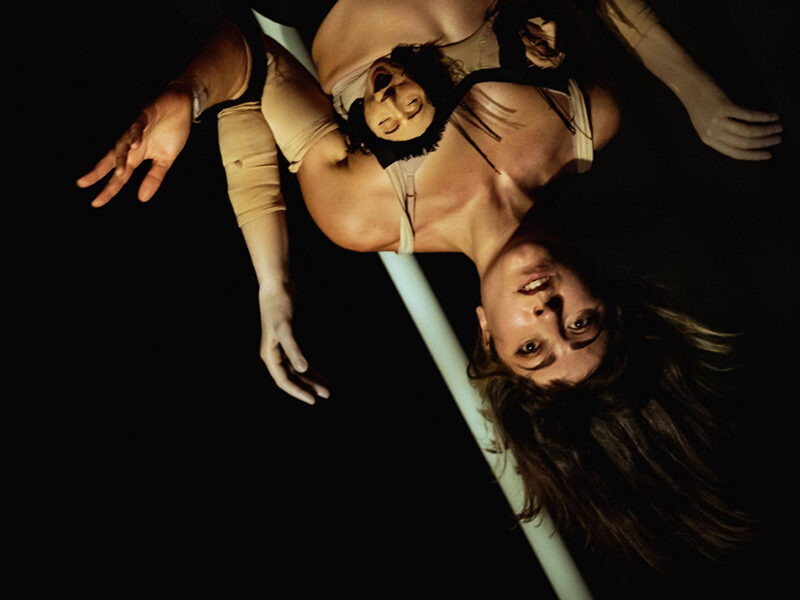
INTERVIEW. La Víspera – Vinka Delgado, Fragments

Being Vinka Delgado. La Víspera’s Surrealism and Playful Identities of Fragments. By Valentina Barone.
As a mainstream motto at the end of the ’90s, can you imagine the invitation of Vinka Up Your Life? In this interview for the 2024 circusnext laureates’ series, circus and plastician artist Vinka Delgado reveals the behind-the-scenes trajectories of the show Fragments, built around the exploration of a multitude of diverse personalities, all embodied in Vinka’s resemblance. Behind three identical masks with different bodies fluctuate different personas. Capable of breaking their uncanny presence to explore interactions, the Vinkaracters on stage help or obstruct each other in a parade of cinematographic situations. Surrealism, plastic morphing, and circus techniques combine with disturbance and irony, navigating a complex imaginary dimension shaped by Vinka’s inventive head. The weirdness of emotions becomes a nuance of absurdity with humour, and the variants of physical virtuosity recall a Lynchian taste. From her French base in Toulouse, right before a creative residency in Italy at Aosta’s TIDA circusnext partner, and after the annual Spanish showcase PDCirco in Madrid, I chatted with Vinka, half of La Víspera company on their brand-new project Fragments, shaped together with the multitasking performer and technical director Diego Hernando.
VB: How did your career as an artist begin?
VD: I started circus very late, around 21 years old. Before that, I experimented with fine arts all my life. I have this background and have done different sports, too. At a certain point, I met circus, and spontaneously, I got driven into that dimension. However, “doing circus” has never been the only point. At the university in Salamanca, I studied plastic arts. For this reason, I consider myself firstly a plastician.
VB: How did you start creating hyper-realistic prosthetics and mixing it with puppetry, where did this passion come from?
VD: It all starts from a very personal surrealistic and dark imaginary world I have known for a long time. I have always been obsessed with portraying body parts in different positions. If you look at my old drawings, they are all about body anatomy and are very similar to what I am developing now. Therefore, my circus style deals with the imaginary ideas I have always found. The interesting point in circus for me is the possibility of blowing the limits of the physicality of circus bodies. I see in the circus an additional tool, linking the body’s physicality with abnormal possibilities, experimenting with what cannot happen with a real body. Circus people are nomads, often with caravans, more into a way of life mixing the arts frequently, and I love the mixing.
VB: How do you develop your ideas into living sculptures, and which materials did you experiment with?
VD: My approach is intuitive rather than structured. Usually, I think a lot and connect ideas before doing something. I am at ease making weird connections, and everything happens more in my head than outside, from an image I have in mind. Then I think of how to manipulate and mix it with body possibilities and build it. An impulse to imagine something can come at any hour of the day, but when I want to experiment with an idea, I do not overthink. If I feel as if I should build something, I go for it. I am impulsive in making things happen to understand if they might work. During the last five years, I did workshops and experimented with different materials. I also spent a lot of time trying even stupid ideas and failing, but now I found my way of doing quite well. I usually start sculpting my ideas with clay. Other materials I experiment with are silicon, latex, thermoplastics and foam.
VB: La Vispera is a company founded in 2020, what is the growth trajectory of your artistic project from then to now?
VD: As a company, La Víspera is my first authorial project, and right now, the work in progress of the show Fragments is taking quite a lot of my time. Diego Hernando got involved in the very beginning, but in the first two creations, it was more me alone, and thinking about it now, managing them as a single artist was challenging. In this sense, you can see Fragments as the third project of La Víspera, the first one we share equally and artistically speaking as a team.
Diego and I met in Granada years ago while working at my first show. He was in charge of the light design and then became the technician travelling with me, and therefore we felt at ease working together. When I started the company during the pandemic, the first creation, The Identity of Vesania, absorbed me completely. The artistic idea was already in the direction of playing with different identities since I wanted to shape a show dedicated to the memory of my mum, who passed away a few years before and had been diagnosed with bipolar disorder.
During the making, I realised the artistic project was too ambitious to handle for my capacity as an emerging artist. There was live music, and the technical conditions were very narrow, not really negotiable. From this delicate and frustrating process, I moved on to exploring the outdoor dimension, shaping another project with a female friend and dancer, Murmullo, again another darkly themed show, dedicated to the concept of “charging your shadow”. We toured a little in the South of Spain, and I regained confidence in my style choices. I felt something was taking space like Fragments was already inside my mind. In the beginning, I wanted to work with the idea of something that was holding the body as parts. I was attracted to exploring how an external touch can affect you, how you deal with things you allow people to do to you in society, and what your responsibility is or what is the attractive factor in the process. Then I had a heartbreak, and my idea twisted, becoming more similar to an inner explosion of parts rather than feeling restrained. So, Fragments became a symbolic evolution of a personal explosion which I was experiencing. From the images of body parts, legs on one side and arms on the opposite, the torso elsewhere, I started writing about this fragmentation, asking myself where I might see the parts of my body all around and play with them, seeing what could happen.
VB: From a more circus point of view, creating a new apparatus opens new technical imaginary possibilities. Where did this idea come from and how did it evolve while shaping Fragments?
VD: As a basic, I trained for a long time in Chinese pole, duo acro and handstands. But I always try to discover how I might use a technique another way. I enjoy working with the power of erotic language treated in a surrealistic way. For me, pole dance is now more and more related to the weird erotic universe we are creating in Fragments. My solo scene using a combined apparatus between a dance pole with a fixed prosthetic torso on top and a pair of looped straps with a prosthetic arm on the end of each one, is still in progress. I found it very intimate and challenging. It is also difficult to shape because of the delicate technical balance between the trapped real arms – which you usually use to balance on a dance pole – and the free legs. We are also considering using a black pole to create the suspended effect of the body moving around in the dark.
VB: Fragments contains a specific taste of dark vibes but breaks them with a humoristic rhythm. How did you arrive at this fascinating alternation of frequencies?
VD: Compared to my previous creations, there are more nuances of irony and absurdity. Diego’s involvement as a technician and performer in the show collided with my universe and helped it become less dramatic. His energy on the team is driving me to more absurd humour. I was already in that direction but not yet pushed forward. Now, we are more and more and it is creating a good balance between the heavy darkness of certain moments and the contrast with the absurdity of the situation.
VB: The show presents a fascinating thin line between human and non-human elements. It makes me think of body parts that somehow become other people, as if each fragment might start to follow its personality. How do your Vinka characters develop their own will and start interacting with each other?
VD: We are still in the process of discovering their personalities by exploring the macro and micro relations between the parts, evolving the interactions between the three Vinka characters as a trio and their solo behaviours. We are declaring the resemblance since it is evident that the three characters are wearing masks. However, the audience is also complicit in the fakeness. You can spot that one Vinka is taller than the other, for example, and it is hilarious, as you are still confused because they are similar. The show plays with two dimensions: the absurdity of the similarity combined with the fictional reality of a film.
The awareness of the involvement of touch between the three Vinkas brings me to ask myself who is aware of being manipulated or responsible for making something happen, where the threshold of permission lies to make something happen with my consent or otherwise. As an author, I am touching a playful territory between myself and my brain. However, the show is not about me. I like to think that what I am suggesting is to pay attention to an internal monologue owned by everybody. All the characters are indeed Vinka. However, each of them can be Vinka in their own way.
VB: At a certain point in the show a camera and video projections appear on stage. Is filming the space and video making also evolving as pivotal elements?
VD: Yes, the video is becoming more and more central, expanding the surreal dimension we are staging. When you overthink, it is also a common saying “You are making a movie in your head”. The scenography is evolving with more tripods and various structures all around; as if the
show is oscillating between a movie set and a surgical room where you can get rid of, build and assemble body parts.
VB: At what point in the creation process did you decide to participate in circusnext and how has the international path offered by the label contributed to your growth?
VD: After the advice of a friend and after the invitation of Roberto Magro to show an extract of the show at his festival, Diego and I decided to apply for the first month of creation together as a team. At the same time as circusnext, I participated in FOCON, the Ésacto’lido format dedicated to shaping personal projects, with my very personal idea of combining object manipulation, pole dance and the world of prosthetics. The supportive process of circusnext gave us a lot of visibility and encouraged us to believe in our ideas. It helped us trust ourselves more and to defend our artistic choices. However, the best impulse we received during the trajectory was through the laboratory experiences. We invited the other participants into our world, and the improvisations and theatrical moments were a breakthrough. Before circusnext, Diego was more in the position of being a technician. He blossomed while reconnecting with his performer’s identity since he is also an actor and a clown. Now, he is one of the Vinka characters and the clever inventor of light and sound remote-control devices, used directly from the stage.
VB: Where are you now in your research, who are you collaborating with, and what are the future trajectories to bringing the show to debut?
VD: Speaking of external collaborators, for me, it’s hard to find confidence in someone. After Roberto Magro as an external eye, we will work with Florent Bergal since he knows me very well from my previous solo project. Lucrezia Maimone is in charge of helping us with the research of movement quality, and Alessandro Angius is shaping the original music. After collaborating with Christine MacKenzie and Anthony Matieu, the third Vinka character on stage is now played by Guille Leoni. In the first part of 2025, we expect a full immersion in shaping Fragments. In February we do a residency at Dynamo Workspace in Odense, Denmark. Other confirmed future residencies are at La Grainerie in Toulouse, France and we will do a Balkan tour with ROOM 100, Cirkorama and Cirkusfera. We would love to do our première in September 2025. The calendar is still in progress!